

Introduction: Where Philosophy Meets Electromagnetic Science – The Art and Science of PCB Grounding
A decade ago, as a novice in PCB design, a senior engineer once asserted that "grounding is more of a black art than a science." Now, with a deep understanding of Maxwell's equations and the ability to expertly manage GHz signal integrity, the true meaning behind that statement becomes clear. The ‘macro’ level involves the vast, governing laws of electromagnetic fields, while the ‘micro’ level is a meticulous battle fought on every inch of copper trace and through every via. A truly skilled engineer must possess both this overarching systemic vision and a profound respect for these minute details. This guide will start from the fundamental theories of electromagnetic fields, delve into the core principles of PCB grounding design, and provide practical, actionable solutions.
The Theoretical Foundation of Grounding Design: The Three Pillars of the Electromagnetic World
The Deeper Meaning of Ohm's Law: Ground Noise Voltage = Current × Impedance
According to the IPC-2141A standard, a 1mm long ground path can exhibit an inductance of approximately 1.2nH at 100MHz (Formula: L=0.2×ln(4h/d)×l, where h is height above the reference plane, d is trace width, and l is length). With a ground current of 100mA and a switching speed of 1ns, the generated ground noise voltage can reach 120mV (V=L×di/dt)—sufficient to compromise the effective accuracy of a 12-bit ADC.
Kirchhoff's Law in PCB Practice: All Currents Must Have a Return Path
Unintended return paths are a primary root cause of EMC issues. When a return path is interrupted by a split in the ground plane, current will find an alternative loop, effectively creating a loop antenna. Data from the IEEE EMC Society indicates that 90% of radiation (exceedance) cases are directly related to violations of current return path principles.
An Engineering Interpretation of Maxwell's Equations: di/dt Generates Magnetic Field Radiation
Analysis of a typical case involving radiation exceedance from an unshielded DDR4 memory module shows that at a data rate of 3200MT/s, with an edge time of just 0.3ns per bit, the resulting magnetic field radiation can be quantified by the formula ΔB=μ₀/(4π)×(Idl×r̂)/r² (μ₀=4π×10⁻⁷ H/m). Measurements confirm that DDR4 modules lacking proper grounding and shielding can exceed limits by 12dBμV/m at the 1GHz frequency point.
System-Level PCB Grounding Design: The Art of Macro-Level Planning
Stack-up Strategy: Performance Differences Between 4-Layer and 6-Layer Boards
A 4-layer board with a continuous ground plane can reduce ground impedance by up to 40 times compared to a 2-layer board (data per IPC-2251 standard). In the 2.4GHz band, characteristic impedance control for a 4-layer board can achieve ±10% accuracy, whereas a 2-layer board typically exceeds ±25%.
Partitioning Principles: The Logic Behind Separating Digital, Analog, and RF Grounds
Ground separation should be based on signal type and frequency characteristics:
-
Digital Area: Low-impedance, large-area copper pour. Decoupling capacitor spacing should be < λ/10 (where λ is the wavelength of the highest frequency).
-
Analog Area: Star-grounding structure, with separate return paths for sensitive circuits.
-
RF Area: 50Ω impedance control, with grounding via spacing < λ/20.
Granular-Level Grounding Optimization: The Meticulous Craft of Micro-Details
The Impact Mechanism of Copper Foil Roughness on Signal Integrity
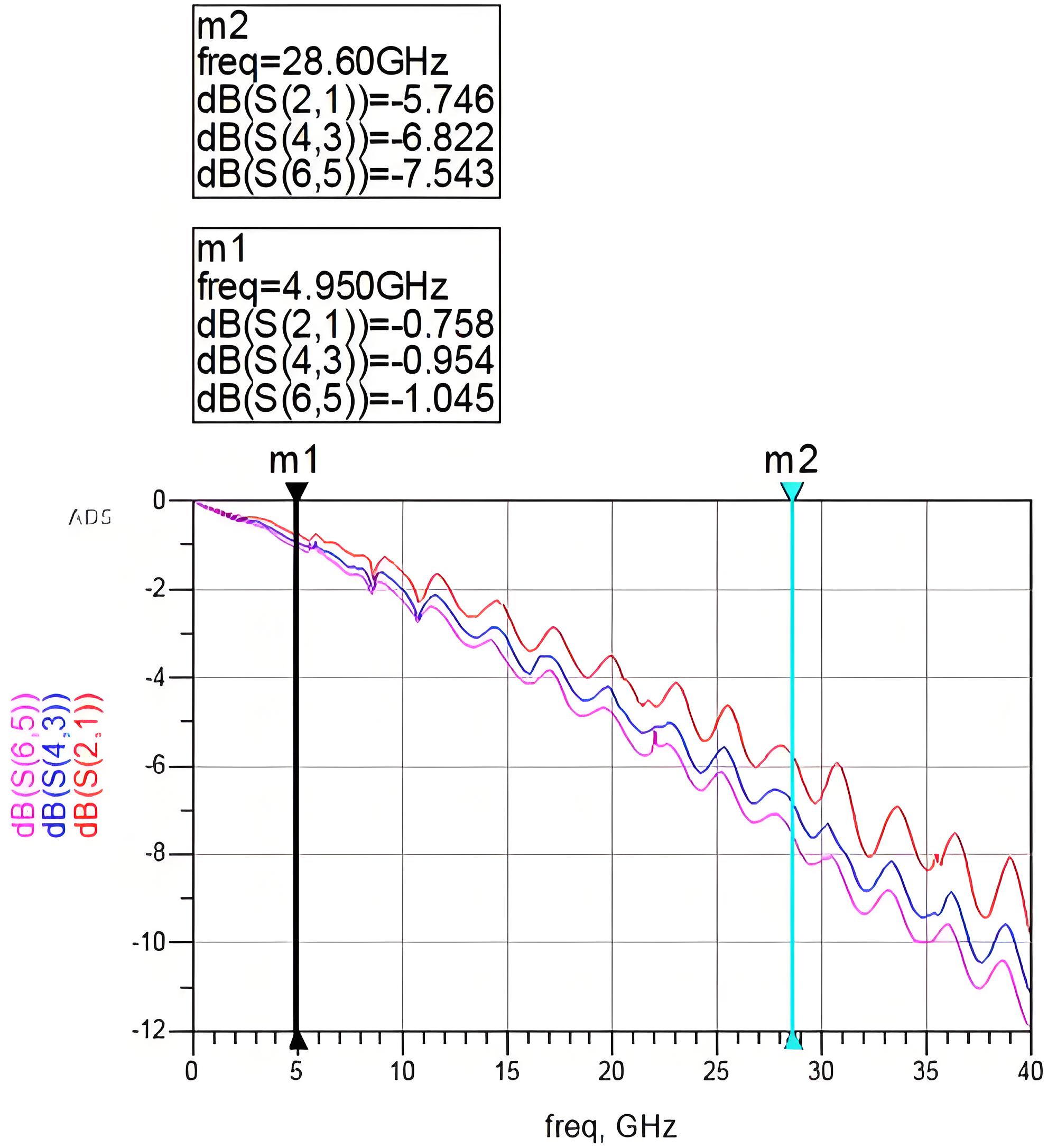
An increase in copper foil surface roughness of 0.5μm (from 0.3μm to 0.8μm) can lead to a 3dB increase in insertion loss for a 10GHz signal (derived from IPC-D-317A standard). For a 56Gbps PAM4 system, this translates to a Bit Error Rate (BER) degradation from 10⁻¹² to 10⁻⁶, necessitating the use of Very Low Profile (VLP) or Extremely Low Profile (ELP) grade copper foil for compensation.
Grounding Via Array Design Specifications
The optimal spacing formula is: d < λ/10 = (c) / (10f√εₑ), where c is the speed of light, f is the highest frequency, and εₑ is the effective dielectric constant. For a 5GHz system (εₑ=3.6), the maximum spacing should be less than 2.8mm. A practical design recommendation is a 1.5mm grid array to ensure a safety margin.
Remediation Techniques for Routing Across Splits
When a sensitive signal line must cross a split in the plane, "guard vias" should be placed on both sides of the trace. The spacing formula is: s < λ/30. For PCIe 4.0 signals (16GHz Nyquist frequency), guard via spacing should be less than 0.6mm, arranged symmetrically to form an electromagnetic shielding tunnel.
Practical Case Study: Grounding Design for an IoT Sensor PCB
Application Scenario and Design Constraints
Case Device: Battery-powered wearable device, featuring:
-
16-bit ADC sensor (90dB dynamic range)
-
BLE 5.0 wireless module (2.4GHz transmit power +10dBm)
-
MEMS microphone with 384kHz sampling rate
-
Space constraint: Double-layer FR4 board, 1.0mm thickness
PCB Material Selection and Cost Optimization
Core Grounding Material List:
-
0Ω resistor (0603 package, ±5% tolerance, for single-point connection)
-
10nF/100nF capacitor combination (X7R dielectric, 0402 package)
-
1cm² copper pour area (to create a local ground reference plane)
It is advised to source components with stable high-frequency characteristics from brands like Murata (GRM series) or TDK (CGA series). Samples and quotes can be obtained from professional PCB and PCBA suppliers.
Three-Step Practical Guide
Step 1: Create Noise Isolation Zones with Physical Segmentation
Step 2: Optimize the Single-Point Connection System
The connection point should be located at the ground pin of the power input filter capacitor. All ground trace widths should be ≥ 0.5mm (impedance < 80mΩ/mm). Use a tree structure instead of a star structure for routing to avoid high-frequency phase shift issues.
Use a parallel combination of 10nF + 100nF capacitors (for complementary resonant frequencies) for each IC power pin. Connect the ground pin directly to a PCB via (0.3mm diameter) leading to the copper pour on the bottom layer. The pour area should be at least twice the size of the chip package to provide a low-inductance return path.
PCB Design Verification and Testing Methodology
Ground Impedance Measurement Techniques
Thermal Infrared Imaging Analysis
Design Adjustments for Advanced Application Scenarios
Grounding Enhancements for Motor Drive Systems
Equipment containing motors/relays requires additional measures:
-
TVS diodes (breakdown voltage selected at 1.5 × maximum operating voltage)
-
Ferrite beads (100Ω @ 100MHz series)
-
Dedicated ground channels for noise isolation
Laminate Upgrade for High-Frequency Systems
A 4-layer stack-up is highly recommended for operating frequencies > 2.4GHz:
-
Layer 1: Signal (impedance controlled)
-
Layer 2: Solid Ground Plane (>80% coverage)
-
Layer 3: Power Split Planes
-
Layer 4: Secondary Signals
Measurements show this structure can reduce radiation by 25dBμV/m compared to a 2-layer board.
Special Grounding Requirements for Medical Devices
-
Right-Leg Drive circuit (Common-Mode Rejection Ratio > 120dB)
-
Star grounding (branch length < λ/100)
-
Isolated power supply (isolation voltage > 4kV)
These measures ensure compliance with ANSI/AAMI EC11:1991 standards.
Conclusion: The Engineering Philosophy of Simplicity
True wisdom lies in using the most commonplace components to safeguard the integrity of every microvolt signal. Excellent PCB grounding design is both a science and an art—it demands that engineers comprehend the universal laws of electromagnetic fields while paying meticulous attention to the microscopic details on the copper canvas. When you need to procure high-frequency PCBs or professional PCBA services, it is advisable to choose a capable and reliable supplier.