

Driven by the demands of high-speed signal transmission and high-density interconnection, plated through holes (PTH) serve as the core interconnection structure in multi-layer PCBs. Their design quality directly impacts signal integrity, mechanical strength, and product reliability.
In PCB design, details determine success or failure. A seemingly simple hole design often dictates the performance of the entire circuit. As a PCB industry expert, I frequently encounter engineers with blind spots in understanding hole properties. This article delves into the distinctions, design specifications, and application scenarios of metalized and non-metalized holes, guided by IPC-2221/IPC-7251 standards.
Essential Differences: Electrical vs. Mechanical Functionality
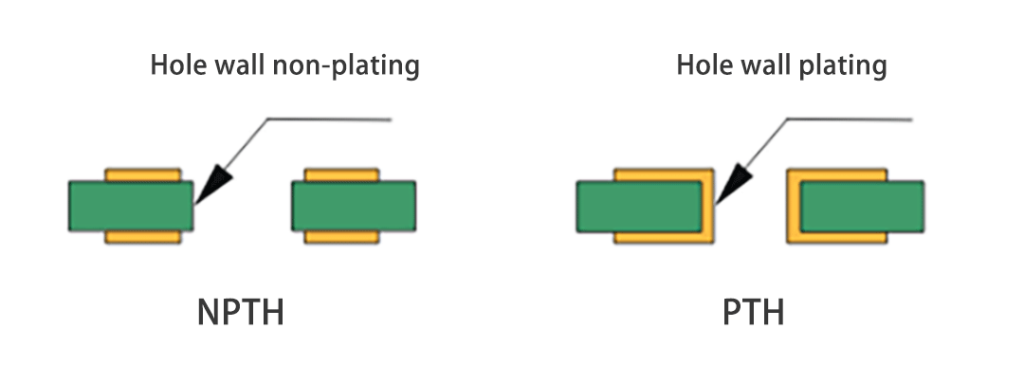
Plated through holes (PTH) feature copper plating on the inner wall, providing electrical conductivity. These holes traverse all PCB layers with conductive metal (typically copper) plating, requiring a diameter ≥0.3mm and copper thickness ≥25μm. Non-plated through holes (NPTH) are simply drilled holes without copper plating, offering only mechanical fixation—ideal for screw mounting or alignment.
Design Standards: IPC’s Golden Rules
IPC-2222 density classifications dictate minimum hole diameters:
- Class A (General Design): Max pin diameter + 0.25mm
- Class B (Standard Design): Max pin diameter + 0.20mm
- Class C (High-Density Design): Max pin diameter + 0.15mm
Annular ring control is critical:
- Minimum: 0.05mm (50μm)
- Recommended: 0.1mm (100μm)
Rings below 0.05mm risk copper peeling under mechanical stress or thermal shock. Case studies show increasing rings to 0.12mm reduces failure rates by 80%.
Application Scenarios: Role-Specific Functionality
PTH applications include:
- Power modules (high-current paths)
- Through-hole components (electrolyytic capacitors, transformer leads)
- Thermal management (connecting heat-dissipating copper layers)
NPTH excels in:
- Alignment holes (precision drilling without plating)
- Screw holes (mechanical fixation)
- Structural support (non-electrical connections)
Manufacturing Considerations: Invisible Boundaries
Aspect ratio (board thickness to hole diameter) must not exceed 5:1. For a 1.6mm thick board, minimum hole diameter is 0.32mm. Ratios >4:1 require filled plating to prevent solder intrusion and short circuits. For NPTH, maintain a no-copper zone around the hole to avoid green oil abrasion during screw installation.
Decision Framework: Precision Selection
- Current Capacity Priority: Use PTH for high-current paths (e.g., power lines). Rule of thumb: 0.5A per hole (1oz copper), requiring parallel vias for current sharing.
- Signal Frequency Consideration: Low-frequency circuits (≤100MHz) can mix PTH and vias; high-frequency (>1GHz) designs prefer blind/buried vias to minimize impedance discontinuity.
- Mechanical Function: Use NPTH for purely mechanical purposes (e.g., mounting holes) to reduce costs and short-circuit risks.
Future Trends: Innovations Enhancing Hole Performance
As 5G and AI drive reliability demands, nanomaterials gain traction. Adding 0.5wt% graphene oxide to electroless copper baths refines grain size from 500nm to 50nm, tripling adhesion. Digital twin technology reduces pad-cratering defects from 18% to 0.7% in semiconductor packaging trials.
Conclusion: Precision Drives PCB Performance
Metalized and non-metalized holes serve distinct roles—PTH excels in current handling and mechanical fixation, while NPTH optimizes mechanical support and space efficiency. Design choices must align with current, frequency, and spatial needs while respecting manufacturing constraints. Adhering to IPC standards and adopting nanomaterials/digital twins enhances reliability, ensuring long-term stability for advanced electronics.
Optimize your PCB design with precision. Contact UGPCB for expert technical support.