

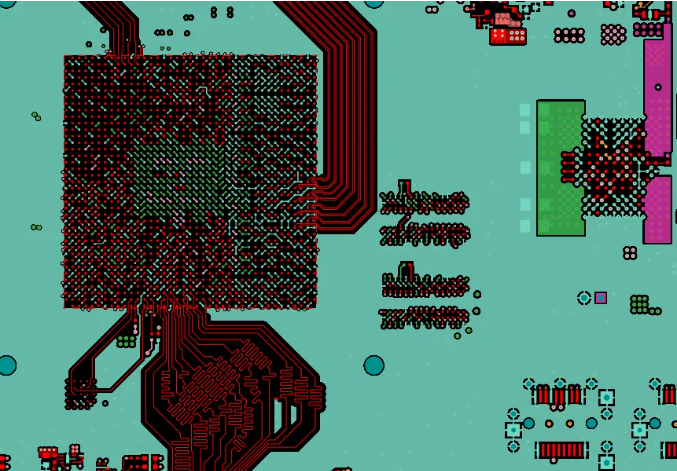
High-speed PCB design prioritizes signal integrity (SI), power integrity (PI), and EMI/EMC challenges. Per IPC-2141A standards, edge rates (rise times) define "high-speed" thresholds—for instance, PCIe 5.0 signals with edge rates below 100ps demand rigorous impedance matching.
PCB Stackup Design & Material Selection
Stackup planning requires balancing layer count, routing density, and interface quantities. A typical 6-layer board employs signal-ground-power-signal-ground-signal layers to ensure continuous reference planes. FR4 suits ≤3GHz applications with loss tangent (Df) values of 0.015–0.025. For high-speed scenarios, Rogers 4350B (Df=0.0037@10GHz) or Megtron 6 minimizes insertion loss.
PCB Impedance Calculation & Control
Single-ended microstrip impedance follows Z₀=√(εr+1.4187)/ln(0.8W+T/5.98H) per IPC-2141A, incorporating field solvers (e.g., Altium Stackup Manager) to account for copper roughness and dielectric thickness tolerances. Differential impedance requires length deviations ≤5mil to prevent reflections and crosstalk.
Tool Recommendations & Practical Advice
Leading EDA tools include Altium Designer (integrated SI/PI analysis), Cadence Allegro (ultra-complex designs), and specialized software. Validate impedance consistency via TDR testing pre-mass production and collaborate with PCBA suppliers to optimize materials and processes.
For professional high-speed PCB design services or premium PCBA procurement, contact our technical team for specialized support.