

In PCB design, teardrops serve as critical reinforcements between pads and traces, much like bridges in structural engineering. However, their application in high-frequency circuits—particularly above 5GHz—requires meticulous scrutiny. While teardrops enhance mechanical stability and mitigate thermal stress, they can inadvertently compromise signal integrity in RF and high-speed digital applications.
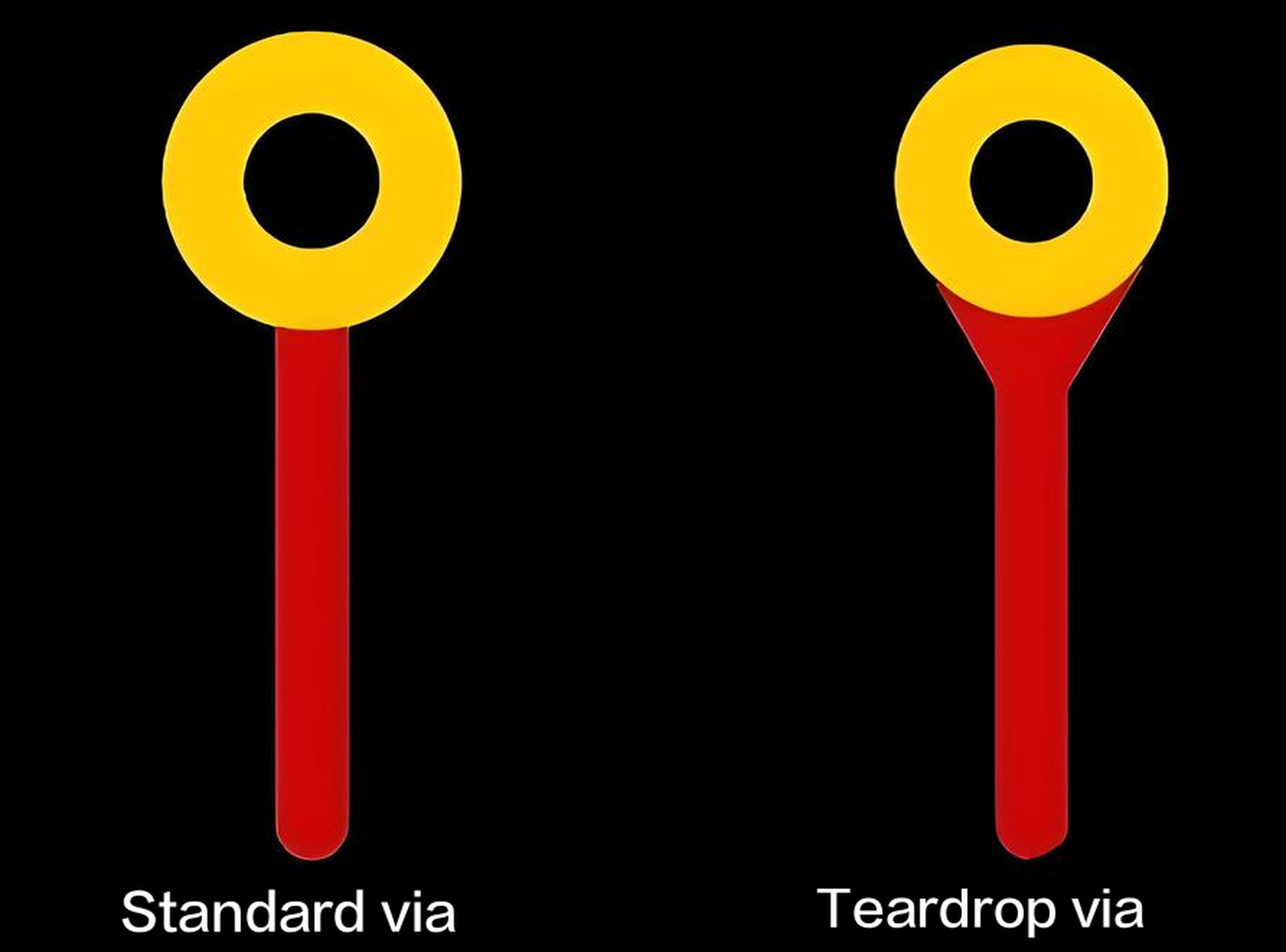
The Dual Role of Teardrops in PCB Reliability
Teardrops improve mechanical strength by distributing stress across a broader connection area. For instance, IPC-6012E guidelines highlight that teardrops can increase pull-off strength by 40%–60% for connectors subjected to mechanical strain. However, this reinforcement can become a double-edged sword. In high-vibration environments, improperly designed teardrops may concentrate stress, leading to premature failure.
Thermally, teardrops act as buffers during reflow soldering. A transitional zone of 0.2mm reduces CTE-induced stress by up to 35%, as documented in IPC-9701 tests. Yet, in multilayer boards, teardrops can exacerbate Z-axis deformation, necessitating material-specific adjustments.
Signal Integrity Challenges Above 5GHz
At frequencies beyond 5GHz, teardrops introduce impedance discontinuities that degrade performance. Simulations reveal that poorly optimized teardrops can cause insertion losses exceeding 0.5dB and impedance deviations of 10%–15%. For example, in 10Gbps SerDes links, these irregularities contribute to bit-error-rate (BER) degradation.
To maintain impedance consistency, designers adopt compensation techniques like tapered teardrops or notch-adjusted structures. These methods minimize reflections while preserving mechanical benefits.
Practical Design Guidelines for High-Frequency PCBs
-
Zoned Application Strategy
-
Critical Areas: Board-edge connectors, BGA escape routes.
-
Restricted Zones: Antenna feedlines, mmWave circuits (>30GHz).
-
Optional Zones: Power supply decoupling capacitors.
-
-
Simulation-Driven Workflows
Electromagnetic field solvers (e.g., ANSYS HFSS) help optimize teardrop geometry. Parametric tools automatically adjust teardrop dimensions based on stack-up properties, ensuring compliance with IPC-2141A for controlled impedance. -
Manufacturing Considerations
-
HDI boards: Use micro-teardrops (extension ≤0.05mm).
-
Thick-copper designs: Apply a compensation factor (copper thickness/3).
-
Soft-board hybrids: Replace right-angle teardrops with elliptical transitions.
-
Conclusion: Striking the Balance
Teardrop implementation must evolve beyond binary choices. By leveraging DFM rules and simulation data, designers can reconcile mechanical robustness with high-speed performance. Partner with a experienced PCB supplier to implement tailored teardrop strategies for your next high-frequency project.