

1. Embrace Multilayer Board Stackups
High-frequency circuits demand controlled impedance and noise suppression. Multilayer PCBs with dedicated power and ground planes (e.g., 4-layer or 6-layer stackups) reduce crosstalk by up to 50% compared to double-sided boards. According to IPC-2141, a 4-layer board with <0.5mm dielectric thickness can achieve characteristic impedance of 50Ω±10%.
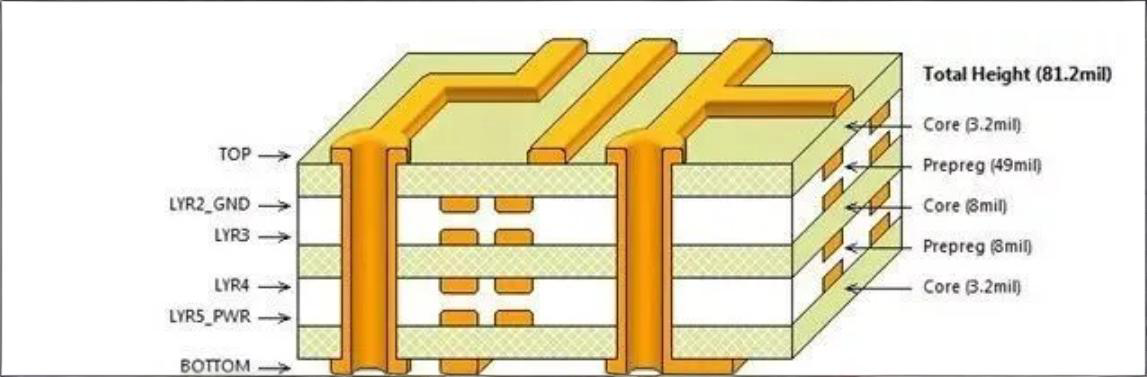
2. Minimize Trace Lengths
Every millimeter of trace adds parasitic inductance. Keep clock signals and differential pairs (e.g., USB 3.0) under 25mm to prevent EMI. Use the time-domain reflectometry formula:
T_prop = L√(LC)
Where L=trace length, L/C=per-unit inductance/capacitance.
3. Optimize Trace Bending
45° or arc bends maintain impedance continuity. Right-angle bends increase capacitance by 20% (per IPC-2251), causing signal reflection. For 10GHz+ designs, use curved traces with radius ≥3×trace width.
4. Reduce Via Transitions
Each via introduces 0.3–0.5pF stray capacitance (IPC-2221B). For 100G Ethernet designs, limit vias to ≤2 per signal path. Use microvias (0.1mm diameter) for HDI boards.
5. Combat Crosstalk with 3W Rule
Parallel traces should maintain spacing ≥3×trace width. For 50Ω impedance, 0.2mm traces require 0.6mm clearance. Crosstalk coupling coefficient:
K = 1/(1+(D/H)²)
Where D=trace spacing, H=dielectric height.
6. Deploy HF Decoupling Capacitors
Place 100pF–10nF X7R capacitors within 1mm of IC power pins. Combine with 2.2μF bulk capacitors per IPC-7351B. This suppresses harmonics up to 5GHz.
7. Implement Strategic Ground Separation
Use ferrite beads (600Ω@100MHz) between analog/digital grounds. Maintain separation ≥0.5mm per IPC-2221. Single-point connect grounds near power supplies.
8. Avoid Loop Areas
Keep return path loops <0.01λ at operating frequency. For 2.4GHz WiFi, loop area should be <12.5mm². Use ground stitching vias every λ/10 along critical traces.
9. Maintain Impedance Matching
Calculate characteristic impedance using:
Z₀ = (87/√(ε_r+1.41))×ln(5.98H/(0.8W+T))
Where ε_r=dielectric constant, H=dielectric height, W=trace width, T=copper thickness.
10. Preserve Signal Integrity
Prevent ground bounce by using <1nH inductance ground connections. For BGA packages, allocate 30% of pins for ground connections per IPC-7093.
Partner with Professional PCBA Suppliers
Implementing these techniques requires precision manufacturing. Consult experienced PCB suppliers for impedance-controlled routing and reliable mass production. Request instant quotes for multilayer RF boards with 1oz copper thickness and Rogers materials.
*Data references: IPC-2221B, IPC-2141A, JESD51-12 standards*