

The Critical Role of PCB Surface Finishes
PCB surface finish is a vital step in the manufacturing process. Its primary functions are to prevent copper oxidation, provide a stable, solderable surface, and maintain signal integrity for high-frequency applications. Bare copper readily forms copper oxide in air, drastically reducing solderability. A high-quality surface finish ensures reliable component soldering and provides a consistent foundation for electrical performance in high-speed circuits.
In-Depth Analysis of Mainstream PCB Surface Finishes
HASL: The Cost-Effective Classic
Hot Air Solder Leveling (HASL) involves immersing the PCB in molten solder (e.g., lead-free SAC305 alloy) and using hot air knives to level the surface. While extremely low cost, it offers poor surface planarity. The high thermal shock, up to 250°C, can potentially lead to board warpage. According to IPC-4552 standards, lead-free HASL typically achieves a solder thickness of 1-5µm. It is suitable for low-density applications like consumer electronics and power supply boards.
ENIG: The Balanced Choice for High-Reliability Applications
Electroless Nickel Immersion Gold (ENIG) deposits sequential layers of nickel (3-6µm) and a thin gold layer (0.05-0.1µm). The nickel layer acts as a diffusion barrier, while the gold provides an oxidation-resistant surface. However, it is known for "black pad risk," which stems from uncontrolled phosphorus content in the nickel (must be maintained at 6-10%) and can lead to brittle solder joints. ENIG is widely used in smartphones and communication equipment, supporting fine-pitch BGA components and gold wire bonding.
OSP: Superior Flatness and Cost Advantage
Organic Solderability Preservative (OSP) forms a thin organic layer (0.2-0.5µm) on the copper surface. This layer dissolves during soldering, exposing the active copper. OSP offers low cost and excellent surface flatness but has a shorter shelf life (typically 3-6 months) and limited resistance to multiple reflow cycles. It is commonly used for high-volume consumer electronics like computer motherboards.
ImSn and ImAg: Specialized Solutions for Specific Scenarios
Immersion Tin (ImSn) forms a thin tin layer (approximately 1µm) through a displacement reaction. However, it carries a risk of tin whisker growth, rendering it unsuitable for high-reliability applications. Immersion Silver (ImAg) deposits a silver layer (0.1-0.4µm) that provides excellent solderability and high-frequency performance, but it is susceptible to sulfur tarnishing. Both finishes require stringent control of storage environments.
ENEPIG: The Ultimate High-Reliability Solution
Electroless Nickel Electroless Palladium Immersion Gold (ENEPIG) adds a thin palladium layer (0.05-0.1µm) between the nickel and gold, effectively eliminating the black pad risk. While it carries the highest cost, its compatibility with both soldering and gold/aluminum wire bonding makes it the premier choice for aerospace, medical electronics, and advanced packaging.
Authoritative Data and Surface Finish Selection Guide
According to the IPC-4556 standard, the palladium layer thickness in ENEPIG must be strictly controlled between 0.05-0.15µm to ensure soldering reliability.
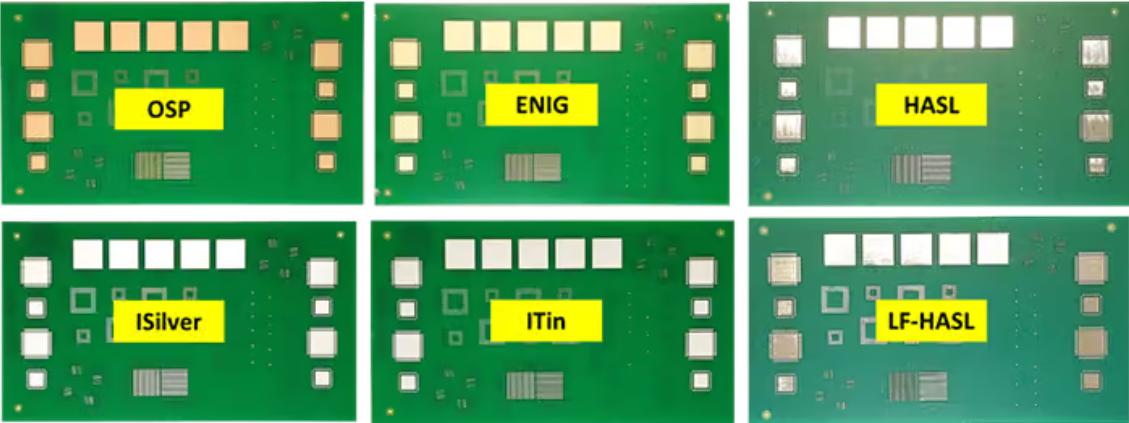
Follow this logical framework for selection:
-
Budget Priority: Choose Lead-Free HASL.
-
Fine-Pitch Requirements: Avoid HASL; consider ENIG or OSP.
-
Wire Bonding Requirements: Prefer ENIG or ENEPIG.
-
Storage Life: For short-term, choose OSP; for long-term, choose ENIG.
Conclusion: Advancing Towards High-Reliability Design
The choice of PCB surface finish directly impacts product longevity and performance. By combining scientific selection with adherence to authoritative standards like IPC-4552 and IPC-4553, you can significantly enhance PCB reliability. For custom PCB and PCBA solutions, contact the professional supplier UGPCB for detailed quotes and technical support.