

The Core Mission of Via Plugging: Building Reliable Electrical and Physical Barriers
After enabling interlayer connections, unconsumed vias on a PCB can create numerous hidden risks during subsequent PCBA assembly if not properly treated. According to IPC standards, its core functions are: Firstly, to prevent molten solder from wicking through the via holes to the component side during wave soldering, causing shorts—a particularly critical issue in densely populated designs. Secondly, to avoid flux residue and solder paste migration into the vias, the latter being a common cause of solder voids. Most importantly, for vias located directly under BGA (Ball Grid Array) pads, plugging is a mandatory pre-treatment step. It effectively prevents gases or flux from escaping through the via during solder reflow, forming voids, or even causing solder loss into the hole, severely compromising the mechanical strength and electrical connection of BGA solder joints.
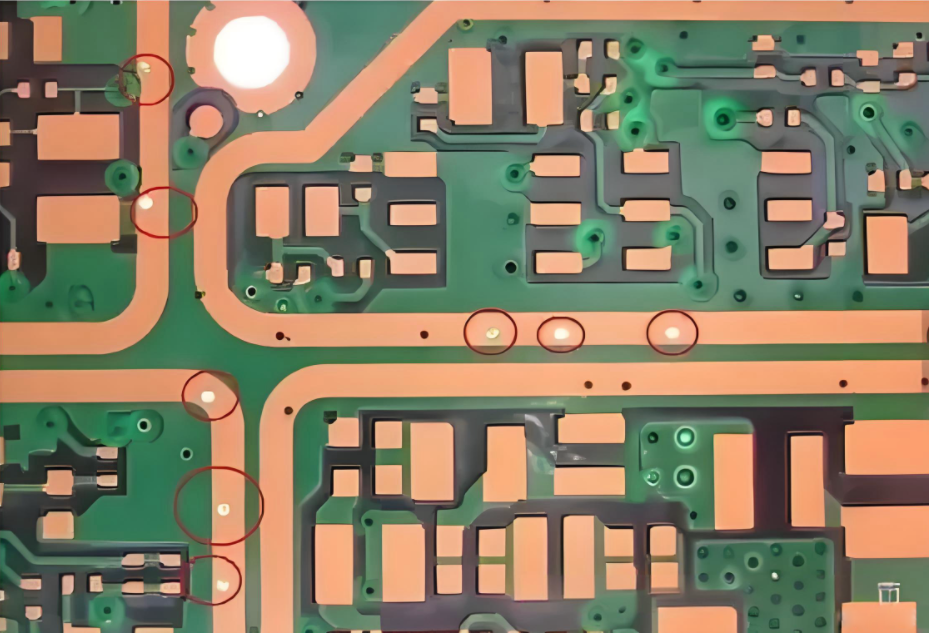
Industry data indicates that without proper via plugging, the failure rate due to micro-shorts caused by hidden solder balls or flux within vias during testing or operation increases significantly. Therefore, a smooth, complete, and void-free via plug is a fundamental requirement for achieving high-reliability PCBA.
Timing for Resin Plugging: When to Plug the Vias?!
The implementation of via plugging varies, and the choice depends on the PCB's end application, cost, and manufacturer capability. Common methods include plugging before Hot Air Solder Leveling (HASL) and plugging after HASL.
-
Plugging After Hot Air Solder Leveling (HASL): This process is simpler but can easily lead to board surface contamination and uneven pads, potentially affecting precise component placement, especially detrimental for BGA soldering.
-
Plugging Before Hot Air Solder Leveling (HASL): This is currently the more mainstream approach, with several sub-methods. The core challenge lies in balancing "plugging fullness," "surface flatness," and "hole copper reliability." For instance, using aluminum stencils for precise plugging followed by pattern transfer and solder mask application can achieve excellent flatness. However, it demands extremely high requirements for copper plating (via wall copper thickness must typically meet IPC-6012 series standard class requirements, e.g., Class 2 or 3) and panel cleaning.
-
Resin Plugging: Widely used in high-layer count boards, HDI PCBs, and designs with strict impedance control or high thermal dissipation requirements. This process employs epoxy resin for filling. After curing and grinding, it achieves a fully flush surface with the board (IPC-A-600M provides guidance on surface finish standards). This not only provides excellent insulation and moisture barrier but also offers additional mechanical support to the via walls due to its high strength, which is crucial for PCBA subjected to harsh environmental stress (e.g., automotive electronics). The surface after resin plugging provides a perfect base for subsequent surface finishes like ENIG (Electroless Nickel Immersion Gold) or Immersion Silver.
Considerations for Process Selection: In-Depth Communication with Your PCB Supplier
Choosing the appropriate via plugging process requires a comprehensive consideration of design, cost, and reliability targets. For designs containing components like BGA or QFN, via plugging requirements must be explicitly specified. When requesting quotes from PCB manufacturers or PCBA suppliers, provide detailed technical documents and confirm their process capability to consistently meet relevant IPC standards (e.g., IPC-6012, IPC-A-600). A successful PCB procurement starts with a thorough understanding and precise control of these critical details.