

Principle Comparison: From "Waterfall Immersion" to "Micro-Surgery"
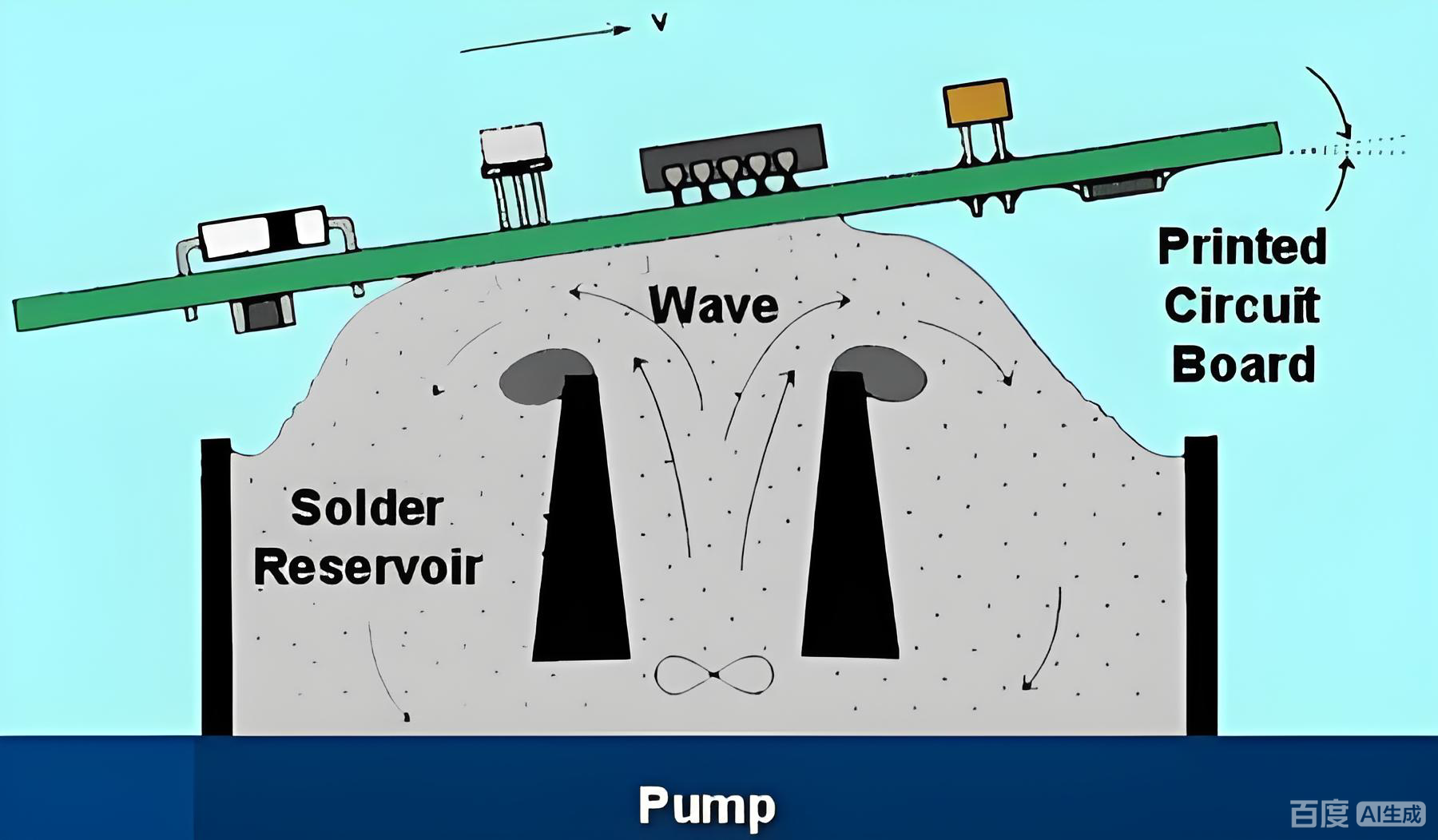
Traditional wave soldering is like subjecting the PCB's solder side to a uniform "waterfall of solder." The entire board passes parallelly over a flowing wave, soldering all exposed pads simultaneously. It is highly efficient; according to IPC standards, conveyor speeds for typical PCBs can reach 1.2-1.8 meters per minute, making it a classic for mass production. However, this large-area, prolonged thermal exposure (preheat typically 90-130°C, solder pot ~250-265°C) acts as a thermal shock, posing a severe test for SMT components like BGAs or precision resistors already assembled on the opposite side.
Selective soldering, in contrast, resembles a robotic "micro-surgery." It uses a miniature solder wave nozzle that moves along a pre-programmed path to locally solder individual through-holes or small areas. Its heat-affected zone is typically confined to within 3-5mm of the joint, with more precise peak temperature control.
Revolutionary Differences in Layout Design
This fundamental difference in principle leads to vastly different PCB layout design rules.
For wave soldering, design must strictly conform to process limitations, centering on the "clean solder side" principle. The solder side (wave contact side) should ideally avoid all SMT components. If placement is necessary, expensive wave soldering pallets are required for masking. Additionally, component orientation (long side parallel to conveyor direction to avoid shadowing), spacing (often >2.5mm to prevent bridging), and distance to through-hole components (industry often requires ≥5mm for pallet mask relief) are ironclad rules. A key DFM technique is adding "solder thieves" or "tail-dragging pads" to direct solder flow and prevent bridging.
Selective soldering liberates layout. It allows SMT components on the solder side, enabling near "double-sided full SMT" layout freedom. Spacing requirements are greatly reduced, allowing components to be placed closer to through-hole parts (e.g., as low as 1.5mm). This makes it possible to solder a power connector next to a dense array of chips on automotive control units or high-end communication boards.
Data-Driven Decision Path
How to choose? A simple decision flowchart can help:
-
Volume & Density: If the board has many through-hole components (e.g., >50), sparse layout, and high annual production volume (hundreds of thousands), wave soldering offers cost and efficiency advantages.
-
Complexity & Reliability: If the board is a high-density interconnect (HDI) design with few through-hole parts surrounded by sensitive components like BGAs and QFNs, and requires high reliability (e.g., IPC-A-610 Class 3), selective soldering is the clear choice.
Statistics show adoption of selective soldering is rising in medium-to-low volume, high-mix industrial and automotive electronics, as it significantly reduces rework costs from thermal damage and soldering defects, improving overall PCBA first-pass yield.
Conclusion & Action Guide
In essence, wave soldering requires design to conform to process, while selective soldering allows the process to serve innovative design. During PCB design and PCBA process planning, the soldering method must be finalized before layout freeze. If your next project struggles with high-density mixed-technology layout conflicts, evaluating selective soldering may be optimal. Consulting a professional PCBA manufacturer or PCB assembly service for a DFM analysis on your design files is a critical step toward successful production.